- Xpeng CEO acknowledges LiDAR remains a good and necessary component in many other industries, but believes the auto industry no longer needs the sensor.
- Xpeng launched the GX SUV yesterday, which, like its other new models, adopts a Tesla-like pure vision autonomous driving solution.
The CEO of Xpeng (NYSE: XPEV) believes LiDAR is no longer a necessity in the automotive sector, as the company continues to push forward with its transition to a pure vision approach.
Although the proportion of models priced above 150,000 yuan ($22,050) equipped with LiDAR is steadily rising in China, Xpeng feels no pressure about it, the company's chairman and CEO He Xiaopeng said during a media briefing on Thursday.
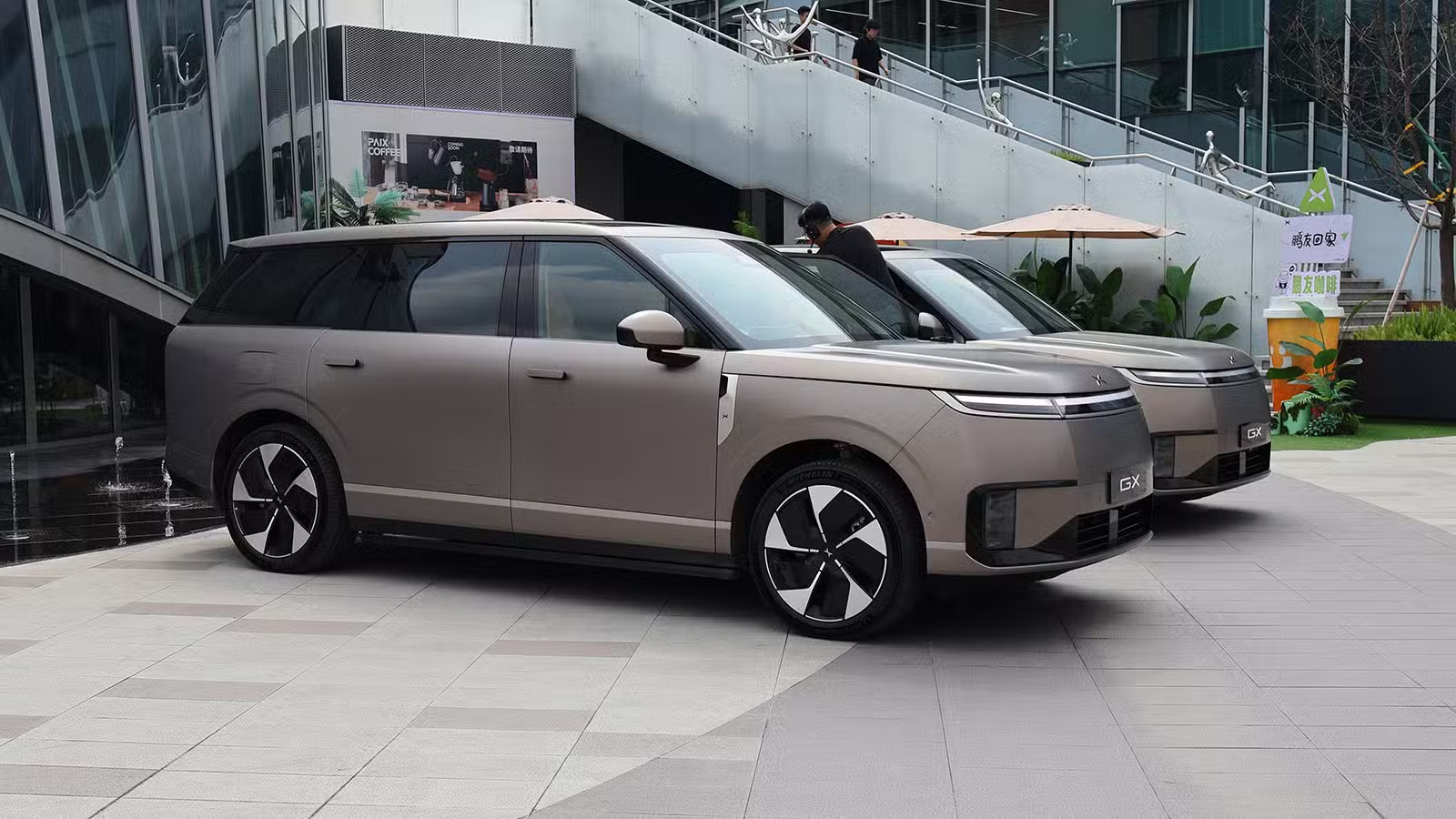
Xpeng launched the new large six-seat sport utility vehicle (SUV) GX yesterday, which, like its other new models, employs a pure vision autonomous driving solution similar to that of Tesla (NASDAQ: TSLA).
He acknowledged that LiDAR remains a good and necessary component in many other industries, but he is firmly convinced that the auto industry no longer needs this traditional physical sensor.
Liu Xianming, head of Xpeng's general intelligence center, provided a detailed technical defense for this strategic shift, stating that whether LiDAR is needed depends entirely on a company's specific technology stack, and there is no absolute answer.
For users, the core metric of autonomous driving is actual performance, rather than the stacking of hardware sensors, Liu said.
Xpeng will stick to the LiDAR-free pure vision route, which relies fundamentally on the actual performance of its second-generation VLA (Vision-Language-Action) system, he said.
Earlier this year, Liu said at another event that if LiDAR is to detect distant objects or penetrate semi-transparent obstacles, it requires extremely high transmission power, a requirement that does not comply with existing strict automotive-grade safety standards.
In extreme weather conditions such as rain or fog, LiDAR generates a massive amount of noise points around the vehicle. In contrast, high-resolution cameras can provide the system with far more information per second than LiDAR, he argued.
In the past, autonomous driving systems lacked sufficient computing power or advanced algorithms to effectively utilize this vast amount of visual information. Now, however, end-to-end large model technology must be equipped with visual signals because its input requires sufficient richness, according to Liu.
Xpeng was the first in the world to introduce LiDAR sensors in mass-produced vehicles. On September 15, 2021, the company launched the P5 electric sedan, with its higher-trim versions using two LiDARs.
After that, multiple Xpeng models followed this strategy, equipped with two LiDARs.
However, in July 2024, an exclusive report by CnEVPost first revealed Xpeng's plan to ditch LiDAR sensors.
Since late 2024, all newly launched Xpeng models have shifted to a Tesla-like pure vision autonomous driving solution.

($1 = 6.8014 yuan)