- Tesla officially confirmed FSD Supervised has entered the world's largest auto market for the first time.
- The announcement follows US President Donald Trump's state visit to China last week, which Tesla CEO Elon Musk joined as a business delegate.
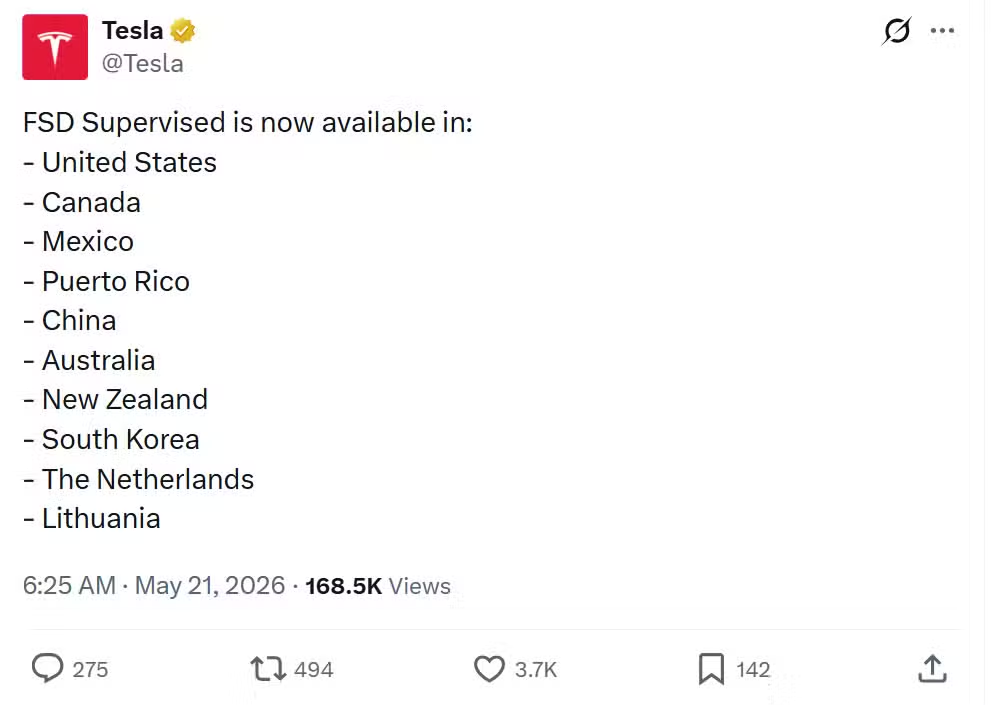
Tesla (NASDAQ: TSLA) announced Thursday on the social media platform X that FSD (Full Self-Driving) Supervised is now available in countries including China.
This marks the first time the US electric vehicle (EV) maker has officially announced the roll-out of its advanced driver-assistance feature in China.
The major breakthrough comes a week after US President Donald Trump's state visit to the country.
During last week's highly anticipated trip, Tesla CEO Elon Musk accompanied the US President as part of a delegation of US business leaders.
Earlier this week, Tesla China posted multiple urgent job openings related to autonomous driving testing. The roles, which include autopilot test engineers and data labelers, sparked widespread industry speculation about FSD's imminent roll-out in the Chinese market.
According to Tesla's post on X, FSD Supervised is also currently available in regions including the US, Canada, Australia, South Korea, and the Netherlands.
The official deployment of the autonomous driving technology is crucial for Tesla's next stage of growth in the key Chinese market.
In the fiercely competitive Chinese auto market, Tesla faces severe challenges from local rivals such as Xiaomi (HKEX: 1810) and Huawei.
These homegrown companies have already made sophisticated urban smart-driving systems standard features in their vehicles, eroding Tesla's technological edge.
A successful deployment of FSD represents more than just a premium feature upgrade; it is a cornerstone of Tesla's long-term financial strategy.
The company is betting on the software to attract tech-savvy consumers and unlock a lucrative stream of recurring subscription revenue.
To comply with tougher local regulations, Tesla has previously established a local data center in Shanghai and forged a mapping partnership with Baidu.
A winding journey
Before FSD truly entered China, Tesla had been allowing car owners to purchase the software for a one-time fee of 64,000 yuan ($9,420).
In February 2026, Tesla discontinued the one-time purchase option for FSD globally, switching to a subscription-only model. However, the Tesla China website still displays the one-time purchase option.
FSD equips vehicles with more advanced autonomous driving features, including auto lane change and summon. These functions are now commonplace on most new EV models in China.
In addition to FSD, Tesla also offers Enhanced Autopilot (EAP) in China, which costs half the price of FSD and comes with fewer available features.
Bringing FSD to China has been a winding process.
As early as 2023, multiple reports suggested that Tesla was about to begin large-scale testing of FSD in China to pave the way for the feature's entry into the country.
In June 2024, local media cited a Shanghai official as saying that Nanhui New City in Pudong was pushing forward a pilot program involving 10 Tesla vehicles to test FSD.
A month later, Musk said on an earnings call that Tesla would likely receive regulatory approval to launch FSD in other markets, such as Europe and China, by the end of 2024.
In September 2024, Tesla announced plans to roll out FSD in China and Europe in the first quarter of 2025, pending regulatory approval.
In February 2025, Tesla began rolling out smart driving features similar to FSD in China, though it avoided mentioning the FSD name.
This was viewed at the time as the preliminary introduction of Tesla's advanced driver-assistance features to China, but no major subsequent updates followed.
In November 2025, Musk said at Tesla's annual shareholder meeting that FSD had received partial approval in China and that he hoped for full approval around February or March.
In late January this year, Musk reiterated that FSD would be approved in China in February. However, the state-owned China Daily subsequently cited a Chinese government source in a report saying this was not true.
Late last month, in conjunction with the release of its first-quarter financial report, Tesla said it was working to launch FSD in the Chinese market as soon as possible.
Although Tesla announced the availability of FSD in China on the Musk-owned X platform, Tesla China has yet to release any related information, and the related content does not appear on Tesla China's website.
Meanwhile, details remain scarce regarding how Tesla will localize FSD for Chinese road conditions.
In February 2025, when FSD was seen as being preliminarily introduced to China, Musk said the company used publicly available videos of Chinese roads and signs on the internet to train FSD.
Tesla faces a dilemma in this regard: China does not allow data to leave its borders, while the US government's chip export ban prevents Tesla from building large-scale computing centers in China.
How Tesla will resolve this predicament will be a major focus of market attention.
Declining sales in China
Since early last year, Tesla has faced ongoing challenges in its sales in China as competition in the market has intensified.
During the 16-month period from January 2025 to April 2026, Tesla saw year-on-year declines in monthly retail sales in China for 12 of those months, according to data compiled by CnEVPost.
For the full year of 2025, Tesla's retail sales in China totaled 625,698 units, a 4.78% year-on-year decline.
From January to April of this year, the figure stood at 138,754 units, a 15.05% year-on-year decline.
In April alone, Tesla's retail sales in China totaled 25,956 units, a 9.66% year-on-year decline, marking the second consecutive month of year-on-year decline.
Compared to 56,107 units in March, Tesla's retail sales in China in April fell sharply by 53.74%.
Strong exports from the Shanghai factory supported the overall delivery volume of Tesla's China operations.
Tesla exported 53,522 vehicles from China in April, marking the second-highest monthly export figure in history, trailing only the 54,504 units exported in October 2022.
In the first four months of this year, Tesla exported a total of 154,122 vehicles from its Shanghai factory. This represents a 127.07% year-on-year surge.

($1 = 6.7955 yuan)