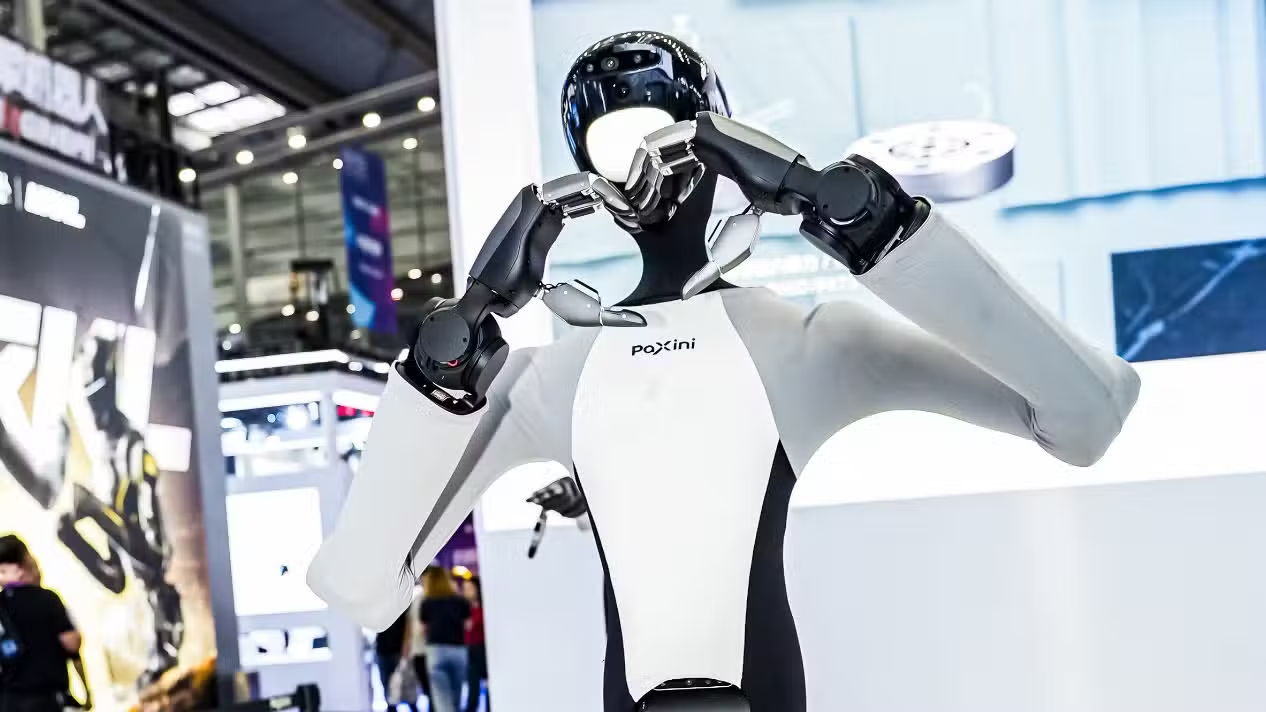
- PaXini completed a funding round of over 1 billion yuan ($148 million) in March, pushing its valuation above 10 billion yuan.
- The company's core products include high-precision tactile sensors, dexterous hands and humanoid robot Tora.
Chinese robotics startup PaXini Tech, backed by new energy vehicle (NEV) giant BYD (HKEX: 1211) and e-commerce giant JD.com, is considering a Hong Kong initial public offering (IPO), Bloomberg reported Wednesday.
The maker of dexterous robotic hands and humanoid robots is the latest in the sector looking to tap investor demand.
PaXini is working with banks on the potential offering and may file an application with the Hong Kong exchange in the coming months, Bloomberg said, citing people familiar with the matter.
The Shenzhen-based company raised more than 1 billion yuan ($148 million) in a funding round in March, which pushed its valuation above 10 billion yuan.
The company was founded in June 2021, and its core products include high-precision tactile sensors, dexterous grippers, and humanoid robot Tora.
In April 2025, BYD made a strategic investment in PaXini, marking the NEV giant's latest foray into the robotics sector following its investment in Agibot.
Excitement is building among investors about Chinese innovation in frontier areas such as robotics, providing a favorable market environment for related companies to capitalize.
Industry peer Unitree Robotics recently received approval for a Shanghai listing, while others such as Beijing Galbot have filed applications in Hong Kong.
PaXini has built high technical barriers in the field of embodied intelligence and is one of the few globally capable of training large models using tens of billions of real-world collected data points.
Its in-house developed OmniVTLA 2.0 full-modality large model upgrades high-precision tactile perception into a core decision-making modality, breaking the bottleneck of traditional models that can only see but not feel, according to the company.
This underlying technological advantage is translating into actual industrial productivity, facilitating a deep strategic partnership between PaXini and Chinese auto giant Geely Auto (HKEX: 0175) in May this year.
Its multi-dimensional tactile humanoid robot Tora-One has been deployed at Geely's Qiantang manufacturing base, executing highly difficult flexible procedures such as automotive wiring harness assembly and pasting, according to a statement last month.
On Geely's production line, Tora-One achieved eight hours of continuous operation with zero anomalies and a task success rate of 99.8%, significantly reducing labor costs.
PaXini's commercial value has also won recognition from Wall Street investment banks, with both Goldman Sachs and Morgan Stanley viewing it as an upstream infrastructure layer in the era of embodied intelligence in recent research reports.
PaXini has captured over 80% of the global robotic tactile sensor market, becoming an indispensable core supplier in the field, Goldman Sachs said.
By independently developing tactile chips and module packaging technology, the company has disrupted the industry's cost structure, drastically reducing the unit price of multi-dimensional tactile sensors to as low as 199 yuan.
This has transformed tactile technology from a laboratory luxury into a mass-producible industrial consumable, further consolidating its data pipeline power in the era of physical AI.
If the IPO proceeds successfully, it is expected to provide ample funding for the expansion of its super data collection factories and the research and development of its full-modality world model, accelerating the large-scale deployment of embodied intelligence.

($1 = 6.7674 yuan)