- BYD's fleet of vehicles equipped with assisted driving has surpassed 2.99 million, generating over 190 million kilometers of driving data daily.
- BYD has ramped up its bets on smart driving technology since last year.
BYD (HKEX: 1211) announced it will hold a smart technology strategy launch event on May 28, where the Chinese new energy vehicle (NEV) giant is expected to unveil new breakthroughs in ADAS (Advanced Driver Assistance System).
This marks another major move for the company following the release of its second-generation Blade Battery and flash charging technology in March.
BYD has stepped up its bets on smart driving technology since last year, rolling out smart driving versions for more than 20 models in a single sweep in February 2025.
Since then, almost all BYD models have been equipped with smart driving systems.
To date, the number of BYD vehicles on the road equipped with assisted driving capabilities has surpassed 2.99 million, with the God's Eye system generating more than 190 million kilometers of valid driving data every day, BYD said last week.
This massive trove of data is used for cloud-based long-tail simulation and reinforcement learning, helping the algorithms achieve highly efficient iterations once every three days.
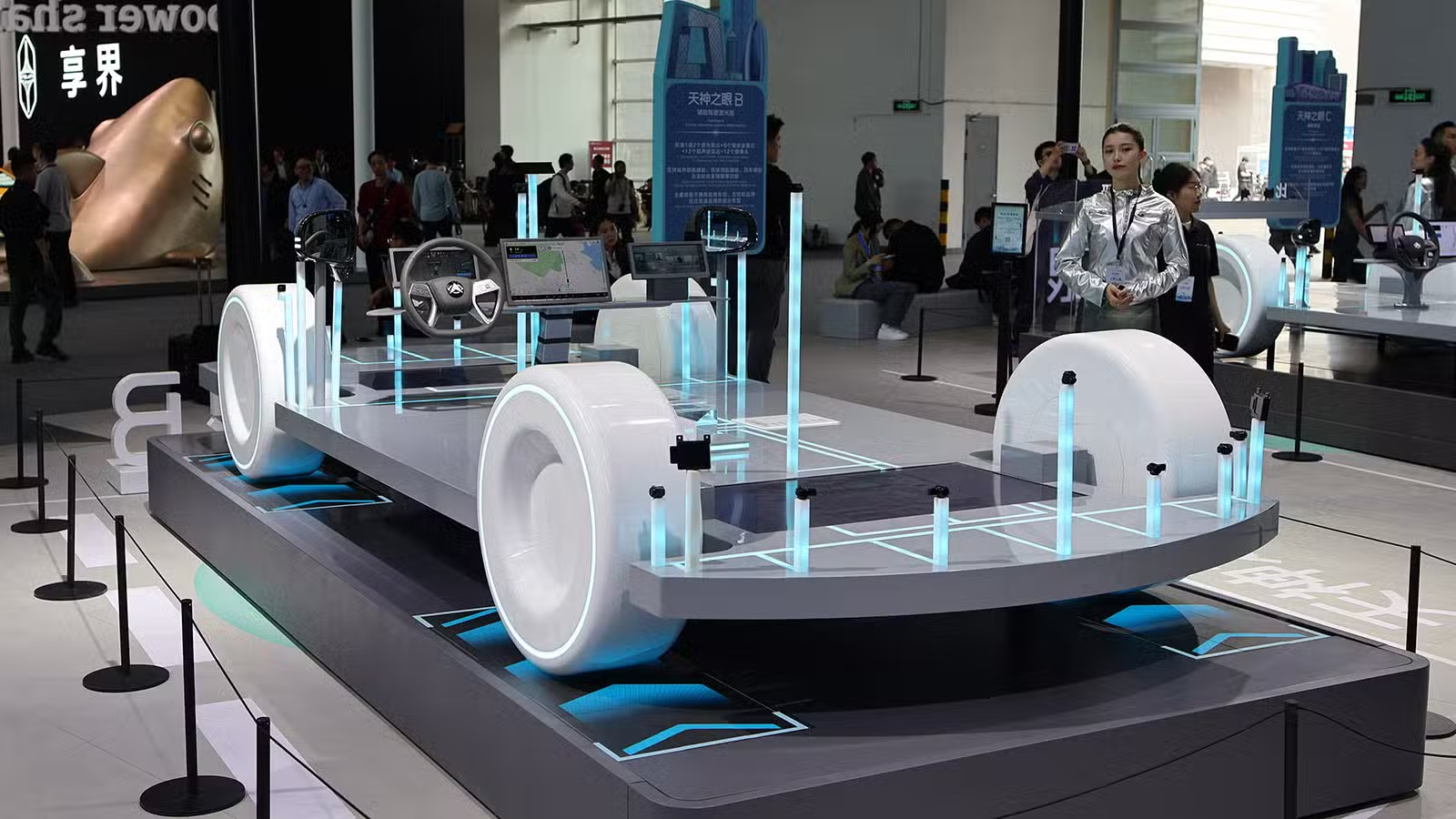
In terms of hardware, BYD's God's Eye system comprises three tiers: A, B, and C. The highest-end tier, God's Eye A, is currently used exclusively in models under its ultra-luxury sub-brand, Yangwang.
God's Eye B and God's Eye C cover models across BYD's Dynasty and Ocean lineup, as well as its Denza and Fang Cheng Bao brands.
Earlier this year, BYD released the God's Eye 5.0 system as its flagship software product for assisted driving.
The core value of smart driving lies in reducing traffic accidents, Yang Dongsheng, BYD's senior vice president and head of the automotive new technology research institute, said at an event in Shanghai on Thursday.
Through a massive installation base of nearly 3 million vehicles across more than 60 models, BYD has validated the core value of smart driving in lowering accident rates and alleviating anxiety for novice drivers, he said.
The system has reduced the rate of severe accidents per 10 million kilometers to one-sixth of that of human driving, and decreased parking scrapes to one-fiftieth, according to Yang.
The company also relies on its in-house developed Xuanji Architecture to integrate the vehicles' electronic architecture with their electrification systems.
Under extreme conditions such as a tire blowout at high speeds, the system can achieve ultra-fast, precise, and stable control within 200 milliseconds, Yang said.
($1 = 6.7921 yuan)