- One former employee faces a massive claim of nearly 10 million yuan ($1.48 million) from Xpeng for an alleged breach of contract.
- The move comes as Xpeng ramps up research and development spending and accelerates talent acquisition.
Xpeng (NYSE: XPEV) is stepping up the protection of its core technologies by launching an internal non-compete investigation targeting former employees.
The probe is primarily focused on key research and development departments, such as Xpeng's general AI (artificial intelligence) and robotics centers, aiming to ensure that departing staff in core technical roles adhere to confidentiality agreements.
Currently, one former employee is facing a hefty claim of nearly 10 million yuan ($1.48 million) for an alleged breach of contract, according to a report by media outlet Guancha on Monday.
Xpeng's legal department has formally filed for labor arbitration regarding the employee's violation of non-compete obligations, the report said.
Upon resigning at the end of 2025, the former employee had confirmed in writing to continue fulfilling a one-year non-compete obligation.
Since the departure, Xpeng has paid the non-compete compensation in full on a monthly basis, yet the employee joined a rival company shortly after, the report added.
Because the employee continued to engage in related R&D work in the new position, Xpeng considers this behavior a suspected severe violation of the non-compete agreement terms.
The company is not only demanding the continued fulfillment of the non-compete obligations but also requesting the return of the compensation and stock sale revenues, along with the payment of a substantial penalty.
The legal action highlights the fierce competition for top AI and robotics talent in China's EV industry, as well as the high priority placed on intellectual property protection.
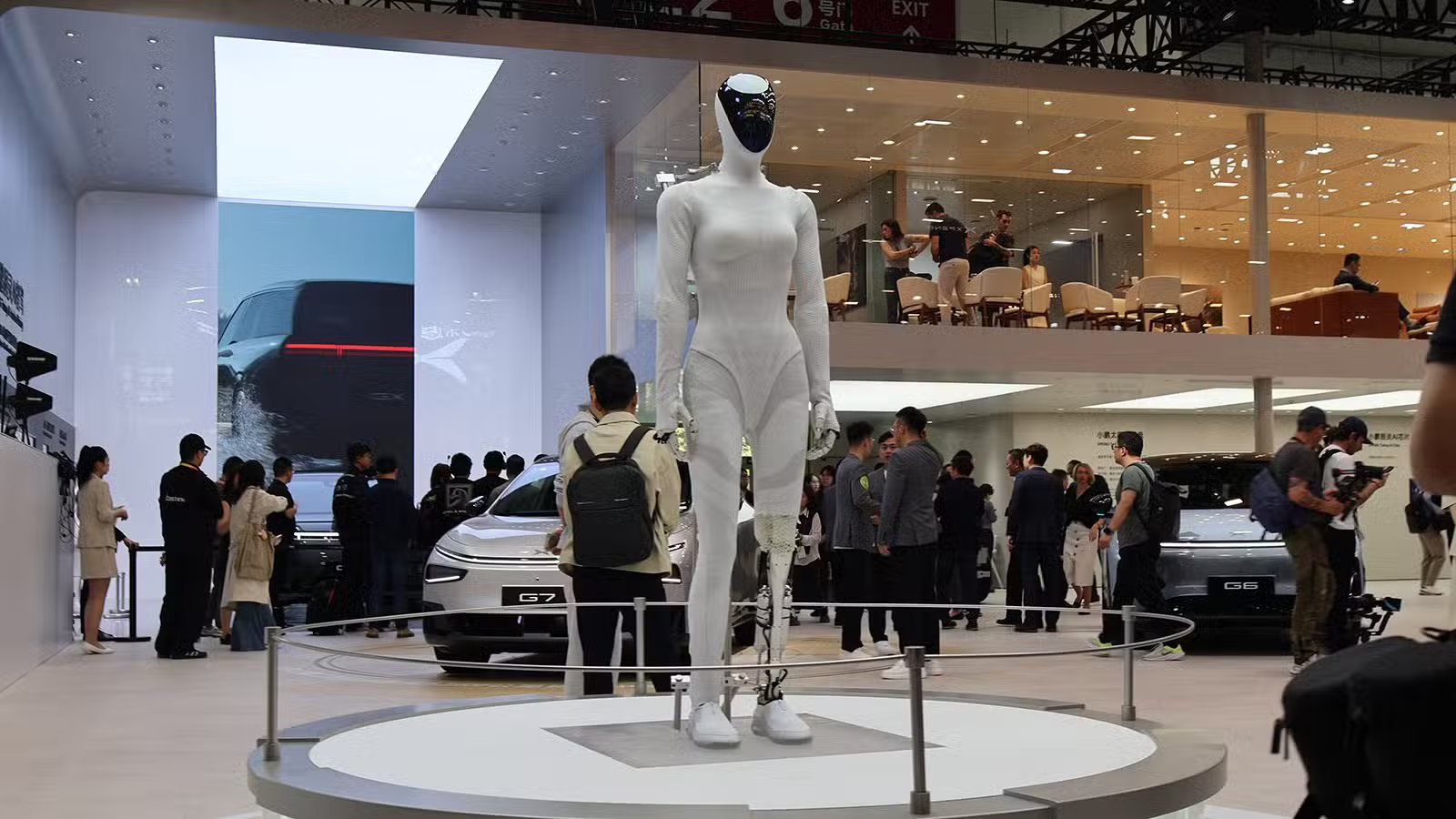
Xpeng is increasing its investments in fields such as physical AI, robotics, and low-altitude aircraft, making technology protection crucial.
The company's R&D expenditure reached 9.49 billion yuan in 2025, with AI-related investments accounting for as much as 4.5 billion yuan, according to its financial reports.
Xpeng is expected to invest about 12 billion yuan in R&D in 2026, with about 7 billion yuan of that going toward physical AI-related research and development, the report by Guancha noted.
As Xpeng ramps up its R&D spending, chairman and CEO He Xiaopeng said in February this year that the company's global headcount will increase by another 8,000 in 2026, with 5,000 coming from campus recruitment.
In an internal letter at the end of February, Mr. He set ambitious targets for 2026: to achieve the mass production and delivery of humanoid robots, flying cars, and robotaxi businesses within the same year.
As technological iteration in the AI and robotics sectors continues to accelerate, talent flows have become more frequent, leaving companies to face the dual challenge of protecting technology and managing talent mobility.
Regarding the arbitration case, Guancha cited legal experts as saying that the key difficulty in non-compete disputes within the high-tech industry in China lies in accurately defining the competitive relationship between companies.
If a competitor's business overlaps with the former company's frontier technology fields, it may constitute a breach of contract, the report said, citing a lawyer.

($1 = 6.7651 yuan)