- William Li said Nio will not exit overseas markets but will slow its pace and evaluate return on investment more cautiously.
- The company clarified the long-term sales structure expectations for its three brands, with the Onvo brand set to contribute 55 percent.
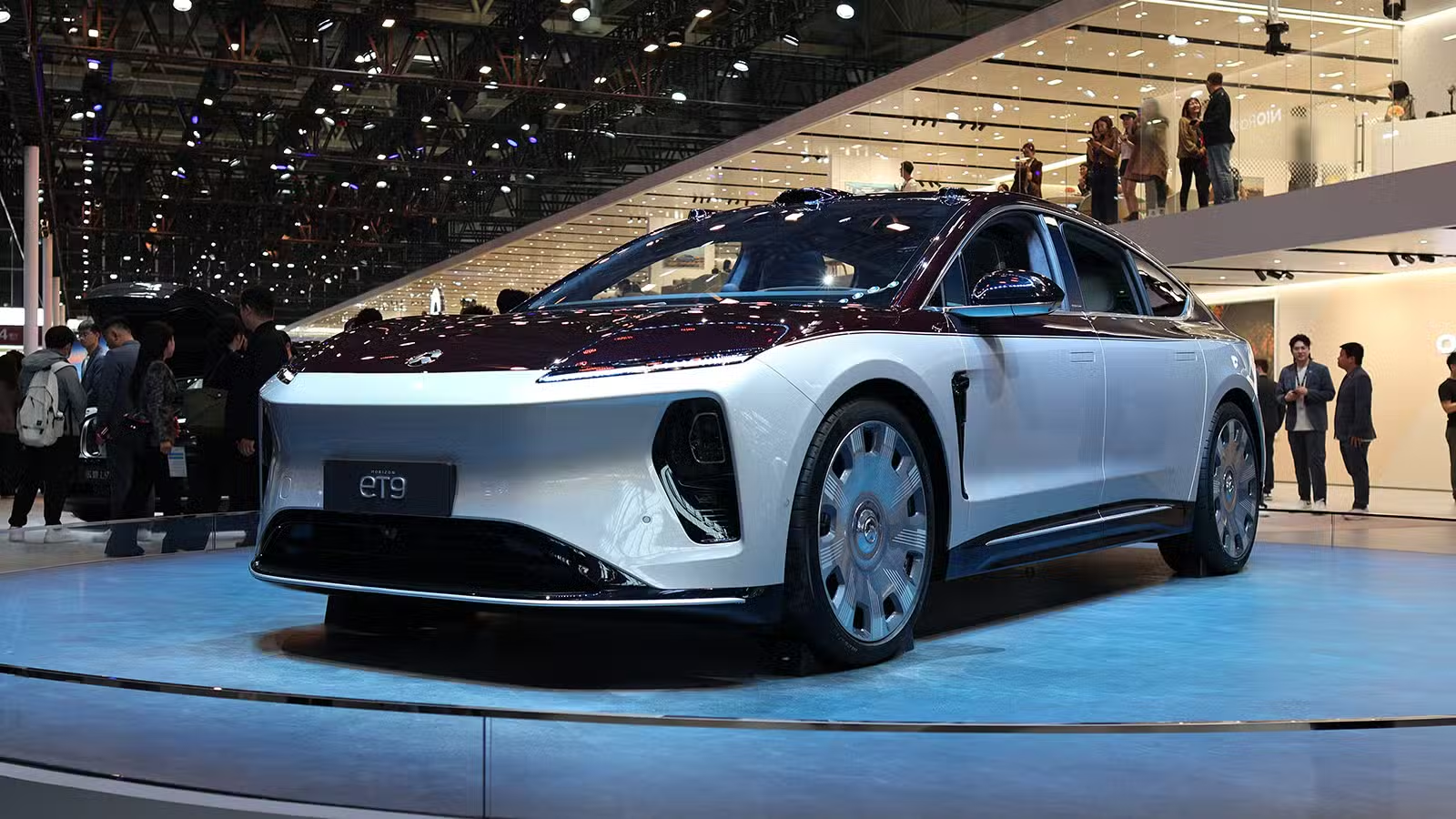
Nio Inc (NYSE: NIO) is adjusting its globalization strategy, as the Chinese electric vehicle (EV) maker slows the pace of its overseas market expansion to refocus on the massive domestic market in China.
William Li, founder, chairman and CEO of Nio, revealed the plan during a small-scale media communication meeting on Saturday, following the company's release of its first-quarter earnings yesterday.
Nio is not exiting overseas markets, but will evaluate the return on investment more cautiously, Li said, according to a report by local media outlet Sina Tech.
He reiterated that Nio will rely more on a local partner model in overseas markets in the future.
For the company, domestic regional markets still hold significant room for growth; for instance, the market size in Xinjiang is already twice that of Norway, the Nio CEO said.
This statement echoes Nio's recent strategic retreat in the European market. In March, CnEVPost exclusively reported that Nio began reshaping its European operations, gradually abandoning the direct sales model in Germany, the Netherlands and Sweden.
The company is shifting to a more asset-light distributor model for these markets in order to maintain its global footprint while controlling costs. Currently, only Norway, which has an extremely high EV penetration rate, retains the direct sales model.
This strategy differs significantly from that of its major domestic peers. Xpeng (NYSE: XPEV) currently exports thousands of vehicles each month, reaching a record 6,006 units last month.
Leapmotor (HKEX: 9863) has even higher export volumes, shipping 14,225 vehicles last month, and is expanding its partnership with European automotive giant Stellantis NV.
Nio's monthly exports contributed a negligible amount to its total deliveries, amounting to just 44 units last month, according to data compiled by CnEVPost.
While slowing its overseas pace, Nio is streamlining its domestic product matrix. Li clarified for the first time the company's long-term sales structure expectations for its three brands: Nio, Onvo and Firefly.
Looking at the long-term picture, the sales ratio among these three brands will generally remain at 3:6:1, or roughly 35:55:10, Li said.
The Nio brand will continue to stick to the high-end market, while the Onvo brand is tasked with tapping into the larger family car market.
If Onvo can achieve a monthly sales volume of 20,000 units, it will reach an important scale, Li said.
The brand's stores are currently still concentrated in first- and second-tier cities, and it needs to build sales channels in more less-developed cities, he said.
For the boutique compact car brand Firefly, management has maintained restrained expectations.
If Firefly's deliveries can increase from the current 5,000 to 6,000 units to 8,000 to 9,000 units, reaching an annual sales volume of 100,000 units, it would already be a good result, he said.
This more pragmatic strategic adjustment comes as Nio's financial situation shows significant improvement. The company achieved its second consecutive quarter of non-GAAP profitability in the first quarter of 2026.
Nio recorded an adjusted operating profit of 66.8 million yuan ($9.7 million) in the first quarter. Total revenue for the first quarter surged 112.2% year-on-year to 25.53 billion yuan.
The improvement in profitability was mainly driven by strong demand for the high-margin ES8 SUV (sport utility vehicle). The large electric SUV, with a starting price of 406,800 yuan, accounted for more than half of total deliveries in the first quarter.
($1 = 6.7981 yuan)