- Greater Bay announced the roll-out of its all-solid-state A-sample cells, claiming key performance breakthroughs and targeting GWh-level mass production in 2026.
- The composite electrolyte route emerges as a differentiated bet, as the company seeks to seize an early commercialization advantage in the global solid-state battery race.
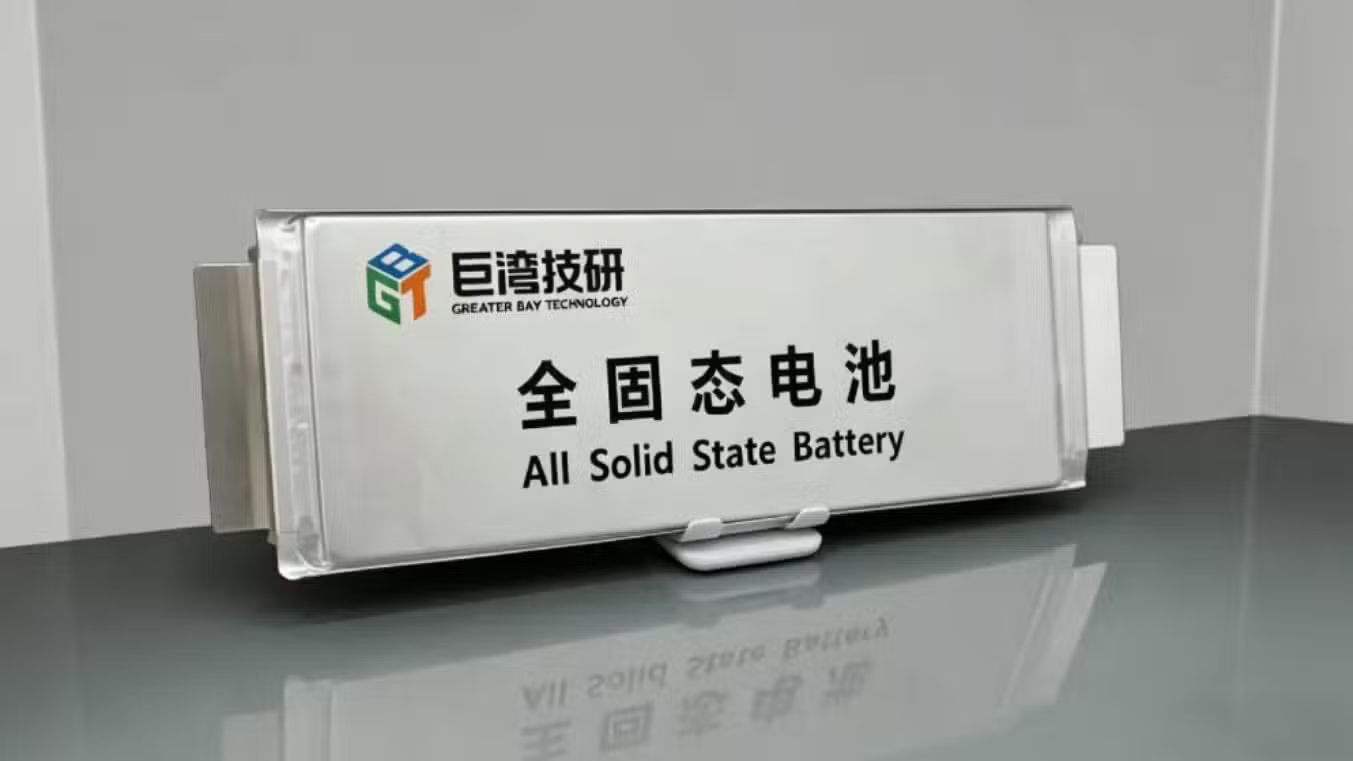
Greater Bay Technology has seen its A-sample all-solid-state battery cell come off the production line, marking a key step forward for the GAC Group-backed battery manufacturer in the race for next-generation batteries.
Greater Bay announced the development on Monday, saying it validates the feasibility of taking the composite electrolyte route from the laboratory to industrialization, laying the foundation for large-scale mass production.
The A-sample cells are completely free of liquid electrolytes and achieved "no fire, no explosion" results in nail penetration, crushing, and thermal shock tests, averting the thermal runaway risks of traditional lithium batteries by design, the battery maker said.
In terms of performance metrics, the cells achieve an energy density of 260 Wh/kg to 500 Wh/kg, significantly higher than mainstream liquid batteries on the market, according to the company.
The new product can achieve stable fast charging of 2C to 3C. This advancement addresses the slow charging issue of solid-state batteries, which is viewed by the industry as a watershed for entering commercial application.
Greater Bay employs a deep eutectic-based composite electrolyte system, enhancing ionic conductivity and structural stability through the synergistic design of multiple materials, it said.
The solution strikes a balance among performance, yield rate, and cost, and distinguishes itself from transitional technologies such as semi-solid or quasi-solid state, the company said.
The A-sample cells have already met the conditions to transition from pilot-scale processes to mass production capabilities at Greater Bay's manufacturing base in the Nansha district of Guangzhou.
Greater Bay has currently applied for more than 50 patents in areas such as solid-state battery electrolyte materials and cell manufacturing. It added that its production yield and consistency have reached automotive-grade standards, providing a basis for subsequent capacity expansion.
The company aims to achieve GWh-level mass production and promote vehicle installation in 2026, a timeline that broadly aligns with the industry's widely expected commercialization window for solid-state batteries between 2026 and 2027.
Globally, solid-state batteries remain in a stage of competing technological routes, with solutions including sulfides, oxides, and polymers all facing challenges such as conductivity and manufacturing complexity.
Greater Bay is one of China's largest battery makers, with an installation volume of 0.21 GWh in the country in March.
That gave the company a 0.37% share of the overall battery installation volume, ranking 15th, according to data from the China Automotive Battery Innovation Alliance (CABIA).