- Volkswagen's adoption of Xpeng's VLA 2.0 as its smart driving solution signifies the partnership's expansion into AI software capabilities.
- Xpeng has set a target of 1 million overseas sales by 2030, with overseas operations expected to contribute over 70% of its profits by that time.
Volkswagen will become the first commercial customer for Xpeng's (NYSE: XPEV, HKG: 9868) second-generation Vision-Language-Action (VLA 2.0) smart driving solution, marking the first large-scale export of a Chinese EV maker's core AI technology to a global top-tier traditional automaker.
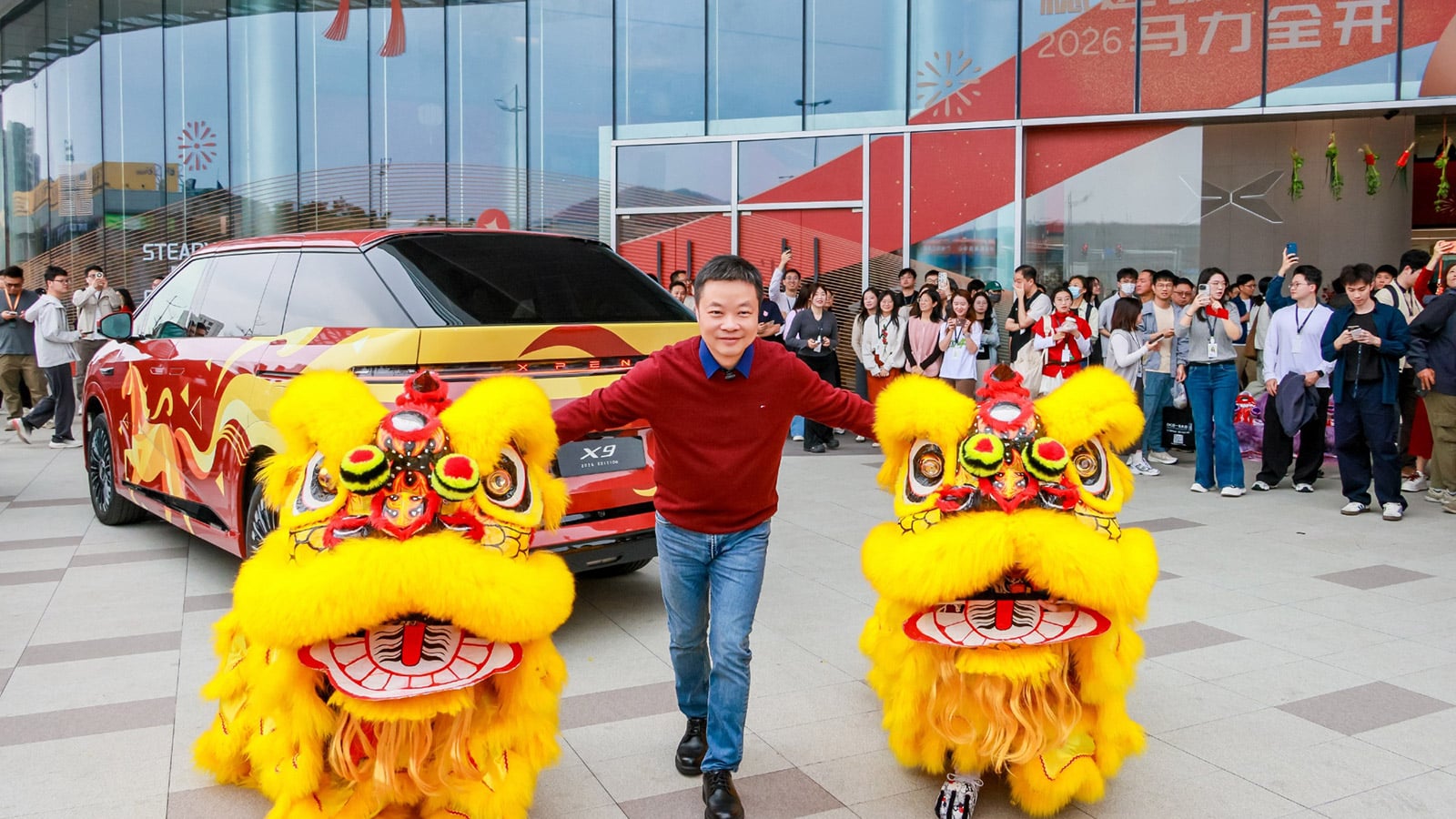
He Xiaopeng, chairman and CEO of Xpeng, disclosed this development in an internal memo dated February 24 — the first working day of the Year of the Horse in China, according to the full text obtained by CnEVPost.
"For a leading global automaker to choose China's AI technology carries meaning far beyond the cooperation itself," Mr. He wrote. "It validates one essential point: we are not only leading in products but at the core technology level we now possess globally competitive capabilities that are scalable and generizable."
Volkswagen and Xpeng's strategic partnership began in July 2023 when the German automaker announced a $700 million investment in Xpeng and joint development of electric vehicles.
Volkswagen's adoption of VLA 2.0 as its smart driving solution signifies the partnership's expansion into AI software.
VLA 2.0 is Xpeng's large-scale end-to-end model built upon understanding the physical world. It supports entry-level Level 4 autonomous driving capabilities, covering complex scenarios like narrow roads and campuses without relying on high-definition maps, while adapting to diverse global traffic habits.
In January this year, Xpeng announced that its VLA 2.0-equipped robotaxis had completed third-party closed-course testing and would soon commence public road trials.
The company said at the time that it would roll out VLA 2.0 software to its regular production models in March, enabling ordinary consumers to experience near-Level 4 smart driving capabilities.
In his internal memo, Mr. He said that he extensively tested VLA 2.0 during the just-ended Spring Festival, experiencing smooth operations and precise predictions in complex road conditions.
The Xpeng CEO said that he clearly sees the inflection point for fully autonomous driving has arrived, stating that the "DeepSeek moment" of autonomous driving has begun.
In early February, Xpeng merged its autonomous driving and intelligent cockpit centers into a unified "General Intelligence Center," enabling shared AI foundation models for both driving decisions and human-machine interaction.
Mr. He envisioned future interactions where users could directly instruct the vehicle: "Bring me to Starbucks for a coffee" or "Take the small road ahead and avoid the next few traffic
lights."
Robots, flying cars, and robotaxis to enter mass production
Mr. He set an ambitious goal for 2026: achieving mass production and delivery of humanoid robots, flying cars, and robotaxis within the same year.
In its automotive business, Xpeng plans to launch multiple new models this year covering key segments, including three extended-range electric vehicles in the first quarter.
In 2026, at least four Xpeng models will enter overseas markets. The Xpeng P7+ sedan has completed trial production in Austria and will soon be delivered across 25 European countries, with plans to expand to over 60 countries and regions globally.
For emerging businesses, mass production of the new Iron humanoid robot will commence by the end of 2026.
Xpeng aims to become the world's first company to mass-produce advanced humanoid robots at scale and will open its SDK (software development kit) to global developers.

The company's flying car division, Aridge, has produced its modular flying car, the Land Aircraft Carrier, on a pilot production line and plans to achieve mass production within this year.
Its robotaxi service will launch pilot operations for ride-hailing models this year, with rapid growth anticipated between 2027 and 2028.
Targeting 1 million overseas sales by 2030
Mr. He said that Xpeng expects to double its overseas sales in 2026.
The company has set an overseas sales target of 1 million units by 2030, with overseas operations expected to contribute over 70% of profits by that time, according to the Xpeng CEO.
In 2025, Xpeng delivered 429,445 vehicles, marking a 125.94% year-on-year increase.
The company delivered 45,008 units in overseas markets in 2025, a 96% year-on-year increase, according to data compiled by CnEVPost.
Xpeng plans to double its overseas sales network to 680 outlets this year, focusing on deepening its presence in five key markets: Israel, Germany, Norway, Thailand, and France.
The company will add 8,000 employees globally in 2026, with 5,000 positions filled through campus recruitment.