- Li proposes standardizing battery cells and reducing chip varieties to unlock over 100 billion yuan in industry-wide cost savings.
- Rapid product iteration has led to severe supply-demand imbalances and massive capital waste, Li warns.
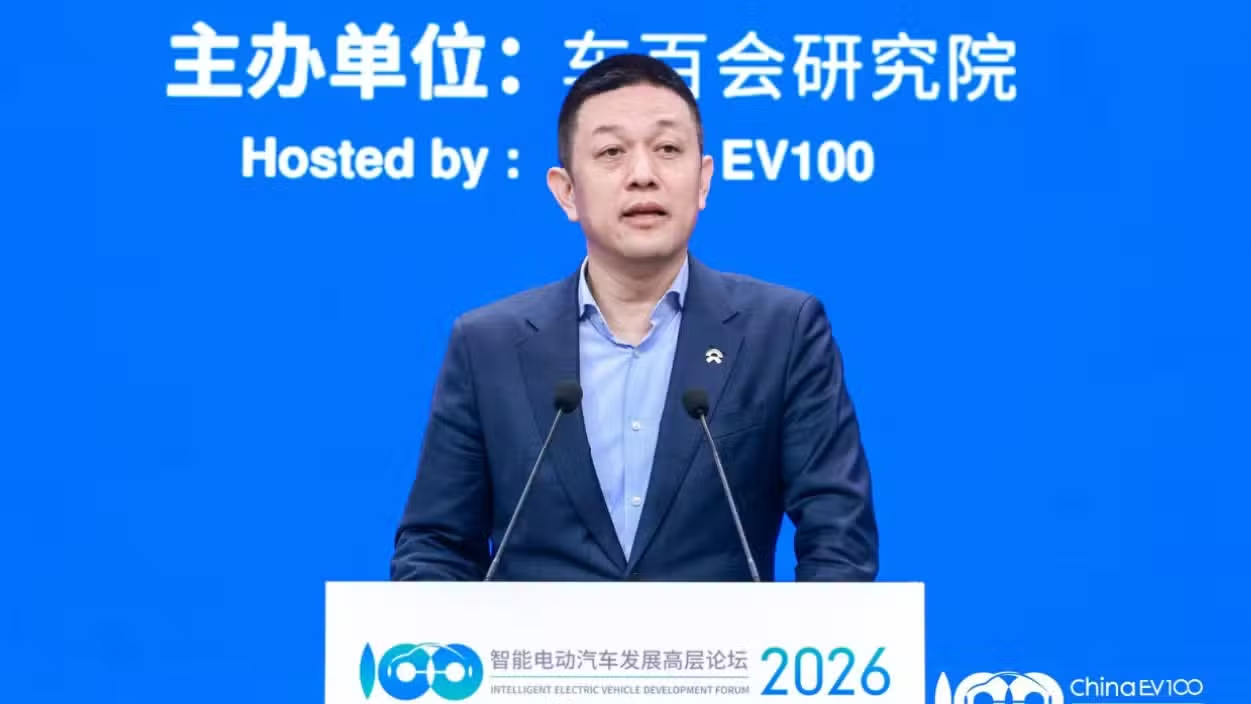
China's electric vehicle (EV) industry must unify battery cell specifications and reduce semiconductor varieties to curb staggering capital waste in the supply chain, according to Nio founder, chairman, and CEO William Li.
Li made the remarks on Saturday at the China EV 100 forum, a call that highlights the intensifying margin pressure in the world's largest auto market.
The extremely fast product iteration speed of smart EVs has disrupted the traditional supply and demand balance, and no new model can currently sustain a full year of hot sales, he said.
This phenomenon leads to severe resource mismatch. By the time automakers invest heavily to ramp up capacity, consumer demand has often cooled.
It is common for hundreds of millions of yuan to be wasted on a single model as a result, Li said, adding that automakers, supply chains, and users ultimately all fail to benefit from this pulse-like demand.
To address this systemic challenge, Li targeted core components that account for over 50% of vehicle costs, urging the entire industry to accelerate the standardization of battery cells.
The current wide variety of battery cell specifications prevents flexible supply and demand allocation, while current battery technology formats have largely converged, making industry-wide standardization possible, Li said.
"The lack of unified battery cell specifications has become a very serious problem restricting costs, efficiency, market response capabilities, and long-term industry competition."
If the Chinese domestic market can unify around four or five standard battery cells, the operational efficiency of the entire industry will be significantly improved, eliminating the overall supply risks caused by sales fluctuations of different models, he said.
The complex variety of chips also drives up manufacturing costs. One example is Nio's newly unveiled ES9, which is equipped with over 1,000 types of semiconductors totaling more than 4,000 chips.
Nio is currently working to drastically slash its internal chip varieties to around 400. Li suggested the industry jointly promote chip standardization and introduce interchangeable standards for each category.
Advancing component standardization is not about shifting profits within the supply chain, but aims to eliminate systemic waste. Li expects these moves to create over 100 billion yuan ($14.6 billion) in cost-reduction space for the entire Chinese auto industry.
This will help elevate the overall profitability of the industry and assist the smart EV sector in achieving healthier, long-term business model viability and sustainable development, he said.
Nio achieved its first-ever single-quarter profit in the fourth quarter of last year, reporting an adjusted operating profit (non-GAAP) of 1.25 billion yuan, largely driven by the performance of its high-margin third-generation ES8 SUV.
The company began pre-sales for the higher-priced ES9 SUV on April 9. The model's official launch will take place in May, with deliveries starting on June 1.

($1 = 6.8280 yuan)