- Nio delayed the mass rollout of its fifth-generation battery swap stations to the summer but is maintaining its annual target of adding 1,000 stations.
- Nio plans to build five to 10 pioneer stations between May and June, featuring a thoroughly redesigned architecture to support the Firefly sub-brand.
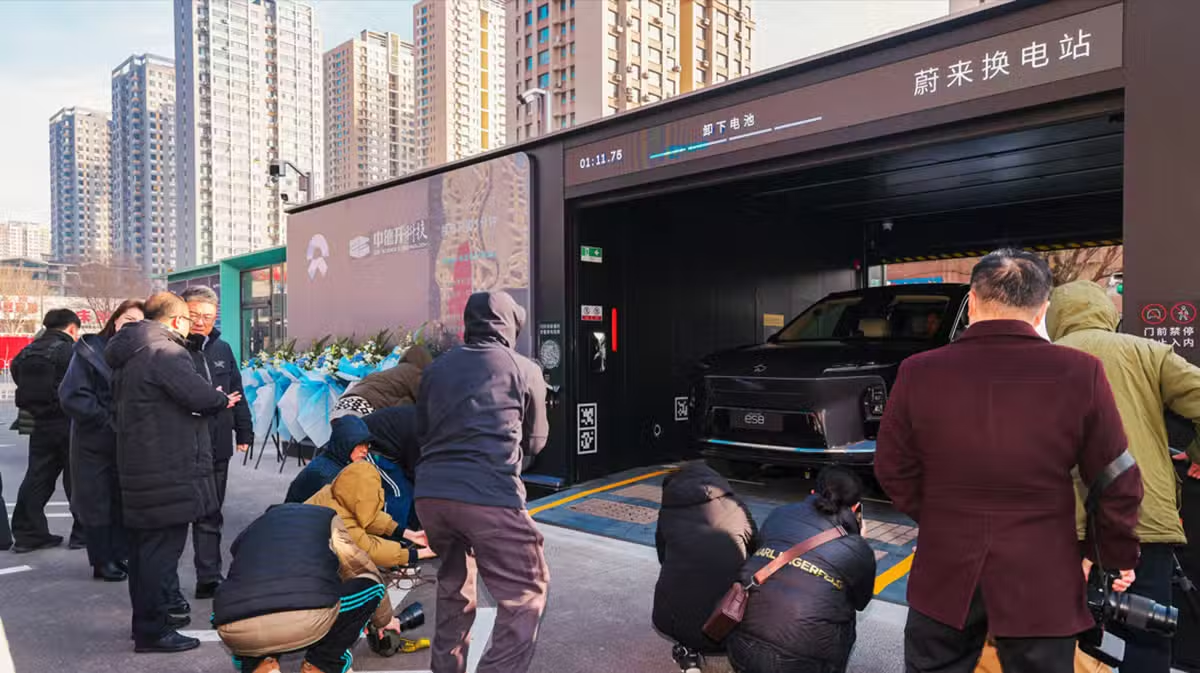
Nio Inc's battery swap stations supporting all three of its brands are coming soon, despite a delay from the original schedule as the company redesigned the facilities.
The company will launch its fifth-generation battery swap stations for internal testing in late March, which will additionally support vehicles from the Firefly sub-brand, Nio management said Saturday at an in-person user event in Wuhan, Hubei province.
Nio plans to build five to 10 pioneer stations between May and June and these few trial sites will be open to users for trial operations.
The mass rollout of the fifth-generation stations will begin in July and August. Compared to previous plans, the timeline for this broad deployment has been delayed.
In September 2025, Nio management said trial sites for the fifth-generation battery swap stations would be put into trial operation before Christmas 2025, with a single station's capacity increasing by 20% compared to the fourth generation.
The delay is attributed to a thorough restructuring of the station's underlying architecture, a redesign that allows the stations to support a wider range of vehicle wheelbases, Nio founder, chairman, and CEO William Li said on Saturday.
This means the new stations can accommodate large vehicles like the upcoming ES9, as well as compact EVs from the Firefly brand. Nio hopes to ensure a high success rate for automated parking through sufficient validation.
Despite the delayed rollout pace, Nio's target of adding more than 1,000 battery swap stations this year remains unchanged, Li said. As of today, the company operates 3,763 battery swap stations in China.
Nio has slowed its infrastructure expansion over the past two years to control capital expenditures. The company added 679 stations in 2024 and 681 in 2025, according to data compiled by CnEVPost.
To achieve its infrastructure construction goals, the company is increasingly relying on partnerships to share costs and revenues, an asset-light model that is also being applied in overseas markets.
In terms of site selection strategy, Nio is placing more stations at highway exits. This approach has been found to effectively serve the needs of both highway transit and county-level markets simultaneously.
Nio's fifth-generation battery swap stations are currently being manufactured in Wuhan's Optics Valley. It plans to increase the number of battery swap stations in Hubei from the current 139 to 200 this year.
Its current fourth-generation battery swap stations were unveiled at Nio Day 2023 on December 23, 2023, and began deployment in June 2024.
The fourth-generation stations are equipped with 23 battery bays, boosting the daily service capacity to 480 swaps and reducing the time per service by 22 percent.
The fourth-generation stations can directly support vehicles from the Nio main brand and its Onvo sub-brand, while Firefly vehicles cannot be supported due to their shorter wheelbase.