- For industry demand, achieving even half of this year's fourth-quarter levels in the first quarter of next year would be a positive outcome, Li said.
- The tapering of purchase tax incentives is expected to trigger significant front-loading of demand in the fourth quarter.
Nio founder, chairman, and CEO William Li anticipates growth pressures across China's electric vehicle (EV) sector in the first quarter of next year as a key national stimulus policy phase ebb.
Li shared this judgment during a small-group media briefing at the company's Shanghai headquarters on September 3, when asked:
If Nio achieves profitability in the fourth quarter this year, it will then face a seasonal slowdown in the first quarter of 2026. How many quarters do you anticipate this profitable trend might last?
This isn't just a challenge for one company -- all players will face significant pressure in the first quarter of next year, Li said, according to an interview transcript released today by local media outlet 21jingji.
With the decline of the vehicle purchase tax incentive, early release of demand will definitely occur toward year-end, Li said.
From an industry demand perspective, achieving even half of this year's fourth-quarter levels in the first quarter of next year would be a positive outcome, he added.
This pressure affects every company -- it's a shared industry challenge, Li said.
"If we're fortunate enough to save some orders for the first quarter of next year, we'll be in a better position," he said.
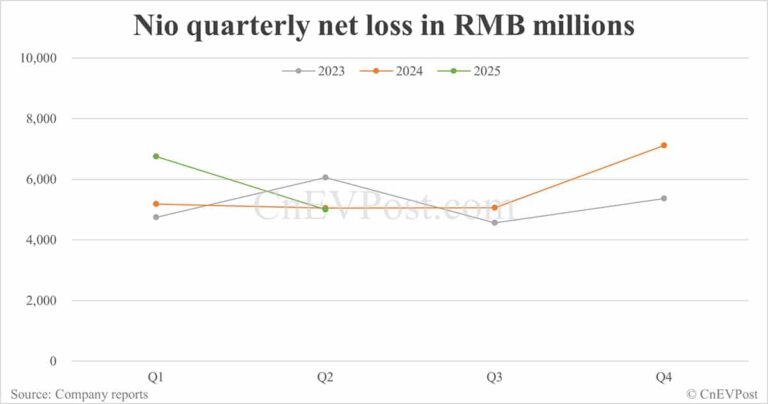
Nio aims to achieve its first non-GAAP profitability in the fourth quarter of this year. For China's auto market, fourth quarter typically marks the annual sales peak.
China's current vehicle purchase tax incentive policy was announced in June 2023, when it was extended for four years to the end of 2027 with a gradual decline by year.
In 2024-2025, the purchase tax exemption for new energy vehicles (NEVs) continues, but the tax break per vehicle is capped at RMB 30,000 ($4,200).
As the policy remained unchanged from last year to this year, no significant surge in demand occurred toward the end of 2024.
From 2026 to 2027, the vehicle purchase tax will be levied at half the standard rate of 10 percent, with a maximum tax reduction of RMB 15,000 per vehicle.
The policy continues to provide additional support for models featuring battery swap capabilities. When purchasing NEVs, if the vehicle and battery invoices are separate, the taxable price is the pre-tax price of the vehicle body.
Nio allows customers to purchase vehicles with batteries included, while also offering a BaaS (Battery as a Service) purchasing option, enabling customers to buy the vehicle body and rent the battery.
On August 8, Nio's sub-brand Onvo said that over 70 percent of customers opted for the BaaS (Battery as a Service) plan when purchasing the L90 large electric SUV (sport utility vehicle).
No data is currently available on the proportion of Nio's main brand customers choosing the BaaS plan. With the reduction of China's purchase tax incentives next year, the proportion of customers selecting BaaS could rise further.
($1 = RMB 7.1396)