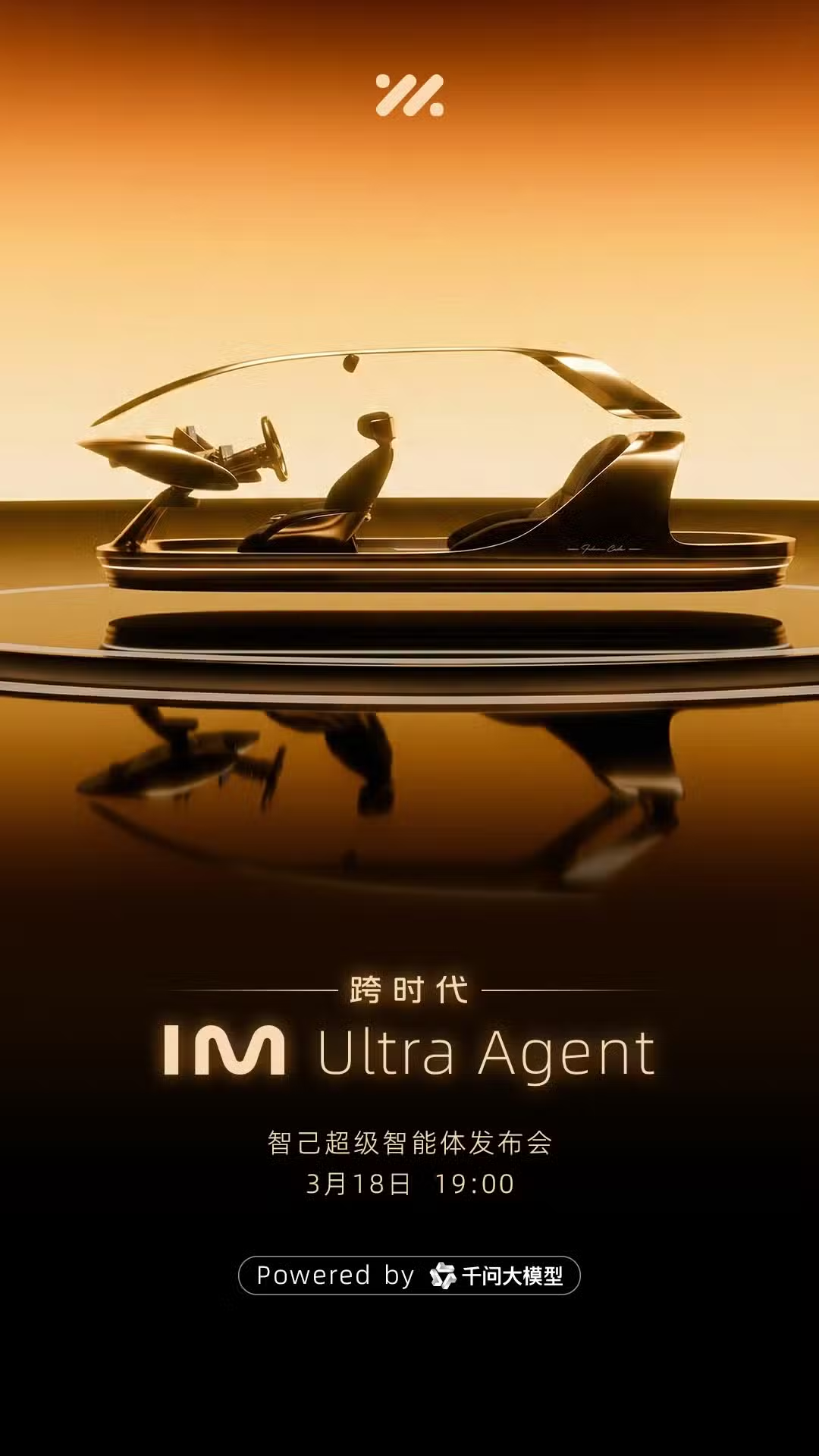
- IM Motors will launch an Ultra Agent based on Alibaba's Qwen AI model on March 18, marking the spread of the AI agent frenzy to the auto sector.
- The EV maker has developed dozens of AI agents that act as "digital engineers" to significantly boost car design efficiency.

As the AI frenzy sparked by the open-source agent OpenClaw sweeps across China, the automotive industry is also feeling the ripple effects.
SAIC Motor's electric vehicle (EV) unit IM Motors announced Friday that it will hold a launch event for its "Ultra Agent" on March 18. This marks the first event dedicated specifically to AI agents in China's auto industry.
IM Motors revealed that these AI agents are built on Alibaba's Qwen large language models.
Founded in November 2020, IM Motors is a joint venture created by SAIC, Zhangjiang Hi-Tech, and Alibaba. SAIC holds the majority stake in the Shanghai-based company.
Notably, the Shanghai Municipal Commission of Economy and Informatization highlighted IM Motors' AI initiatives in a WeChat post in November 2025.
The IM Motors team had developed more than 30 AI agents, each taking on specific responsibilities in the company's daily operations, according to the WeChat article.
Their scope of work is extensive: some agents handle project selection, others manage the packaging and distribution of requirements, while a separate group specializes in providing auxiliary consulting services.
When multiple agents collaborate efficiently, they form individual "digital engineers." These digital engineers can independently complete complex tasks, according to Luo Wenfa, a senior AI application expert at IM Motors.
For instance, when sending requirement documents to suppliers, the digital engineers can directly locate the agents. They will retrieve standards and regulations from various databases to automatically generate the required documents.
This AI technology is drastically transforming the traditional automotive manufacturing process. R&D engineers now only need to input a few parameters into their design software. Within seconds, the AI agent can generate a 3D model of an auto part.
In the past, it took an engineer about two to three hours to design a hood reinforcement plate, with each proposal requiring at least 10 iterations. Now, AI can draft dozens or even hundreds of structural designs in a fraction of the time.
IM Motors chief technology officer Xiang Jiao noted that using AI for development and design presents three major challenges, including a shortage of data. The team addressed these issues by parameterizing and structuring the knowledge of human engineers.
Xiang likened this R&D process to planting lotus flowers, saying that once a tipping point is reached, the team will be greeted by a pond full of blooming lotuses.
The arrival of these digital engineers is not intended to replace human employees. Instead, they are designed to collaborate more efficiently with human engineers.
Humans will be responsible for setting the general direction, while different AI agents will interact and compete to generate better ideas, Xiang said.
As one of IM Motors' backers, Alibaba is currently one of the strongest players in the AI sector.
Earlier this month, the e-commerce giant open-sourced four small-sized AI models from its Qwen3.5 series, which are specifically designed for resource-constrained devices and lightweight applications.
Tesla CEO Elon Musk publicly praised these models on the social media platform X, commending them for demonstrating "impressive intelligence density."