- Xiaomi's humanoid robot successfully operated autonomously for 3 consecutive hours at a self-tapping nut assembly station in its EV factory.
- The deployment marks a significant advancement for Xiaomi in embodied intelligence, positioning it to compete with rivals like Tesla and Xpeng in humanoid robotics.
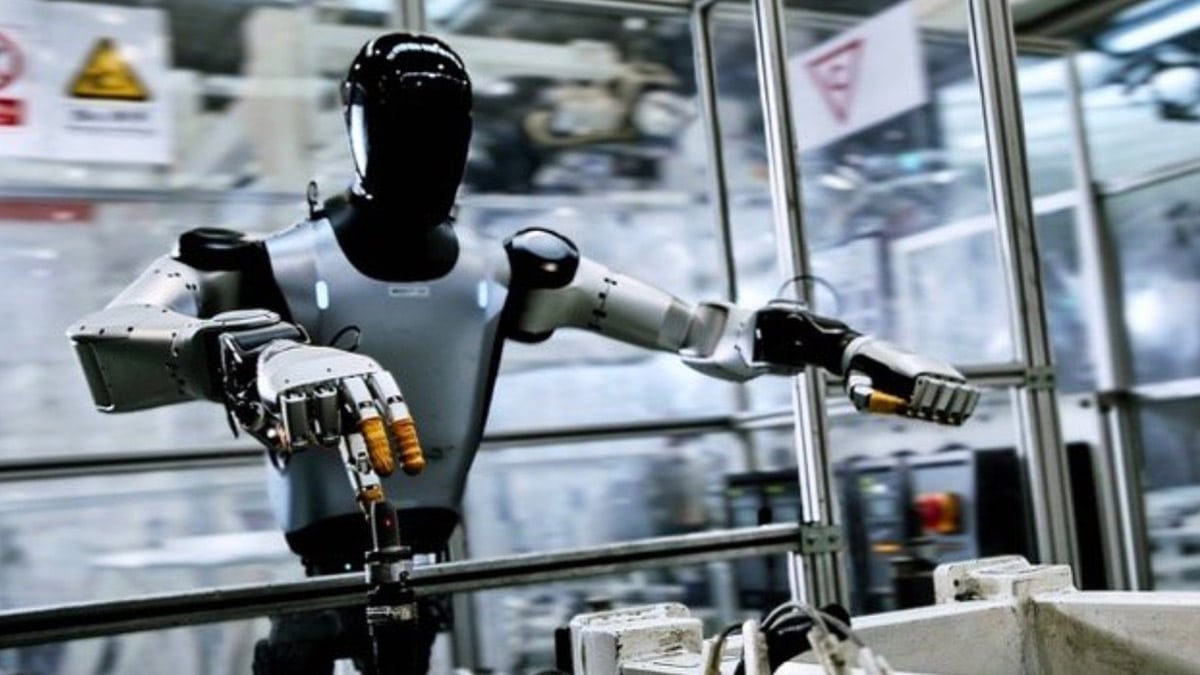
Xiaomi (HKG: 1810, OTCMKTS: XIACY) has taken a pivotal step in embodied intelligence, with its humanoid robot officially entering a real automotive factory to participate in complex component assembly work.
The robot successfully achieved 3 consecutive hours of autonomous operation at the self-tapping nut installation workstation in Xiaomi EV's die-casting workshop, according to a Monday Weibo post by Xiaomi.
Test data shows the robot achieved a 90.2% success rate for simultaneous installation on both sides of the workstation. This performance also met the production line's fastest cycle time requirement of 76 seconds.
The task requires the robot to precisely pick self-tapping nuts from an automatic feeding device and place them onto positioning fixtures. It then coordinates with slide conveyors and automatic positioning to complete automated tightening of floor components after integrated die-casting.
Xiaomi said the greatest challenge lies in achieving precise alignment and reliable engagement of the self-tapping nuts. The spline structure inside the nuts, the non-fixed gripping posture, and interference from magnetic forces significantly increased assembly complexity.
To address these challenges, Xiaomi adopted an end-to-end data-driven control approach. This solution leverages its in-house developed 4.7-billion-parameter VLA (Vision-Language-Action) large model, Xiaomi-Robotics-0, combined with reinforcement learning technology.
This joint training framework reduces reliance on real teleoperation data. It enables the robot to rapidly adapt to diverse operating conditions and continuously learn from interactions with the physical environment.
Additionally, Xiaomi integrated multimodal information including vision, tactile feedback, and joint proprioception. This reduces the probability of misjudging states in complex scenarios, enhancing operational stability and robustness.
For full-body motion control, Xiaomi employs a hybrid architecture integrating optimization control with reinforcement learning. The optimization controller solves each iteration in under 1 millisecond, ensuring real-time system responsiveness, Xiaomi said.
The reinforcement learning controller underwent training through hundreds of millions of simulated random perturbations in a virtual environment. This enables the robot to maintain balance under extreme disturbance conditions and achieve zero-shot transfer to real robots.
Xiaomi said that the self-tapping nut assembly station marks the first step in scaling its humanoid robot applications within automotive manufacturing. The company is currently conducting deployment and validation across multiple other typical workstations.
These include tasks such as bin-picking and front badge installation. Xiaomi is focused on overcoming the core bottleneck of "production cycle time and yield rate" to drive broader industrial deployment.
Lei Jun, founder, chairman, and CEO of Xiaomi, predicted in a separate WeChat post on Monday that large numbers of humanoid robots will begin working in Xiaomi factories within the next five years.
Xiaomi's advancements in humanoid robotics come as global tech giants accelerate their investments in embodied intelligence. Competitors are also actively advancing mass production and application of robots.
Tesla (NASDAQ: TSLA) CEO Elon Musk previously said that by the end of 2026, the Optimus robot is expected to perform more complex tasks. Tesla plans to launch the mass-produced version of its third-generation humanoid robot in the first quarter of this year.
Chinese EV maker Xpeng (NYSE: XPEV, HKG: 9868) is also accelerating its robotics initiative, planning to commence construction of the industry's first humanoid robot mass production base in Guangzhou during the first quarter of this year, targeting large-scale production by late 2026.