- Morgan Stanley believes progressive developments in VLA and physical AI will help convince investors that Xpeng is more than just an auto company.
- Analysts believe the launch of VLA 2.0 will position Xpeng at the cutting edge of the L3/L4 autonomous driving rollout.
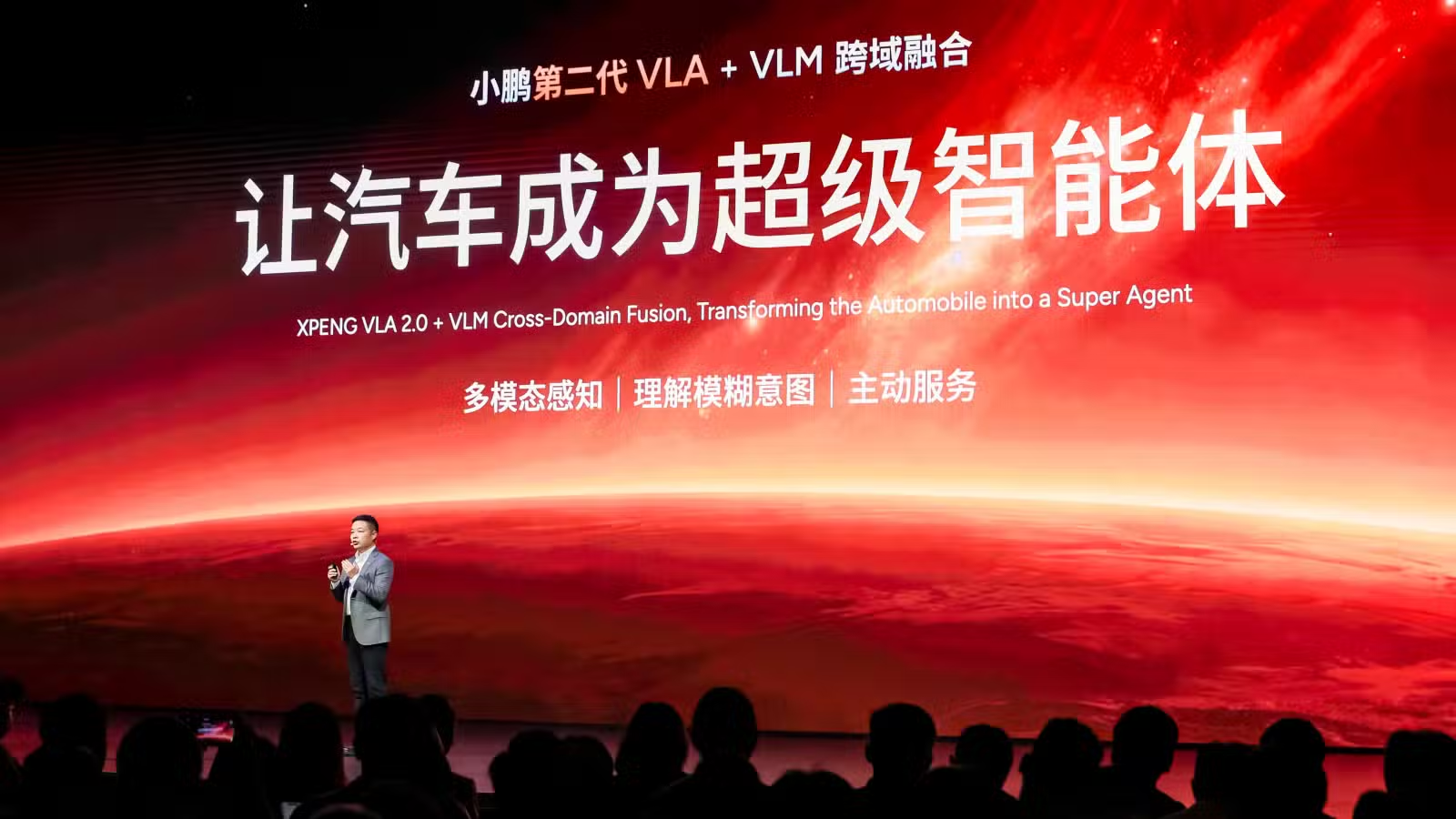
Xpeng (NYSE: XPEV, HKG: 9868) officially launched its second-generation Vision-Language-Action (VLA 2.0) smart driving solution on Monday, exciting Wall Street.
A Morgan Stanley team led by analyst Tim Hsiao called Xpeng's VLA 2.0 "a bold leap forward to capture the X factor" in a research note published Monday.
The bank maintained its Overweight rating on Xpeng and set a price target of $34, representing a 94% upside potential.
The analysts believe progressive developments in VLA and physical AI will help convince investors that Xpeng is more than just an auto company.
They noted that with VLA 2.0 serving as a foundation for physical AI applications like robotaxis and humanoids, Xpeng will position itself at the cutting edge of the L3/L4 autonomous driving rollout later this year.
While Xpeng's stock has faced a near-term correction, largely reflecting geopolitical tensions and a modest start to 2026 sales, Morgan Stanley expects more bi-powertrain model launches to drive store traffic and boost order intake.
The analysts said that the current valuation conservatively mirrors the pure auto business, while there is significant call option value embedded in Xpeng's non-auto initiatives.
At its media experience day on March 2, Xpeng officially unveiled its long-awaited VLA 2.0. The company claims the new model's inference speed is 12 times faster than the previous generation.
Xpeng said that VLA 2.0 will enable a smoother, more efficient, and human-like driving experience, with better handling of complex scenarios and corner cases.
The system will first roll out to the Ultra versions of the new Xpeng P7, G7, and X9 in late March, while other models will receive over-the-air (OTA) updates in April.
Morgan Stanley noted that it is time for Xpeng to lock in more licensing revenue. Volkswagen will become the initial external customer to adopt Xpeng's VLA 2.0, and more OEMs could eventually follow suit, the team said.
Xpeng also launched the 2026 X9 battery electric multi-purpose vehicle (MPV) today. It starts at 309,800 yuan ($45,010), matching the extended-range electric vehicle (EREV) version introduced late last year, but represents a 50,000 yuan, or 13.90%, price cut from the older pure electric X9.
Xpeng chairman and CEO He Xiaopeng later said at a briefing that internal testing shows VLA 2.0 is nearly five times ahead of top-tier industry peers in terms of takeover rates, smoothness, and supported operational scope.
Mr. He said his firm belief that fully autonomous driving will be realized within one to three years, and all cars will become super intelligent agents within three to five years.
Regarding robotaxis, Xpeng management is confident in operating fully autonomous robotaxis on Guangzhou roads once VLA 2.0 is in full swing. The robotaxis are scheduled to hit the roads later this year.
Morgan Stanley believes that while initial deployment could be small, the competitive unit economics (UE) from adopting on-sale passenger vehicles should lay a favorable groundwork for the commercial expansion of its robotaxi fleet.
The note also warned global auto majors that a reverse autonomous driving (AD) innovation from China is coming, as Xpeng plans to roll out VLA 2.0 globally in 2027.
The analysts said that global bellwethers like Tesla (NASDAQ: TSLA) will likely face more Chinese competition from companies like Xpeng, which are capable of matching their AD capabilities in global markets.

($1 = 6.8826 yuan)